

Danish craftsmanship in stainless steel furniture: what small‑batch production delivers
Alloy, surface, and exposure determine performance
In interiors, stainless steel endures when three variables are aligned: alloy, surface condition, and exposure. Austenitic grades such as 304, 316, and 316L rely on a chromium‑oxide passive film that reforms after light abrasion. The stability of that film depends on chromium, nickel, and molybdenum content; surface roughness; and the presence of chlorides from kitchen cleaners, de‑icing salts, or sea air. Smooth finishes reduce micro‑crevices where moisture can stagnate, while brushed finishes balance visual tactility with straightforward upkeep. For most living spaces, a refined No.4 or hairline brush on 304 works well if maintained correctly. In coastal interiors or pool‑adjacent rooms, 316L or additional surface treatments provide a margin of safety against pitting. Acier Studio specifies and finishes with these trade‑offs in mind; the workshop in Aarhus pairs finish selection with expected use so the passive layer remains stable in daily life.
Weld quality and heat control in Aarhus small‑batch work
The microstructure around a weld largely decides long‑term corrosion behaviour. Excess heat and poor shielding produce heat‑tint and a chromium‑depleted heat‑affected zone. Local corrosion resistance then drops, even on high‑grade alloys. TWI Ltd describes the remedy clearly: control amperage, maintain inert gas coverage on both sides of the joint, limit heat input, and remove heat‑tint before returning the part to service (TWI Ltd heat tint welding FAQ). In practice at Acier Studio, low‑heat TIG with clean fit‑up and rigorous back‑purging keeps the underside of the weld bright. Joints are then dressed to the surrounding grain, followed by chemical passivation to restore the chromium‑rich oxide film. This is where small‑batch production matters; each weld can be tuned, cooled, and inspected without pushing parts through a fixed‑speed line.
A typical sequence for a furniture joint at Acier Studio includes:
- Precision fixturing and joint fit‑up, low‑heat TIG with matched filler, continuous argon shielding and back‑purging, interpass cleaning, progressive mechanical dressing to reinstate grain direction, and final passivation with thorough rinse and dry
This discipline prevents sensitisation, keeps the critical‑pitting temperature where it should be, and ensures the visual calm of stainless steel survives years of handling.
Inside the Aarhus workshop
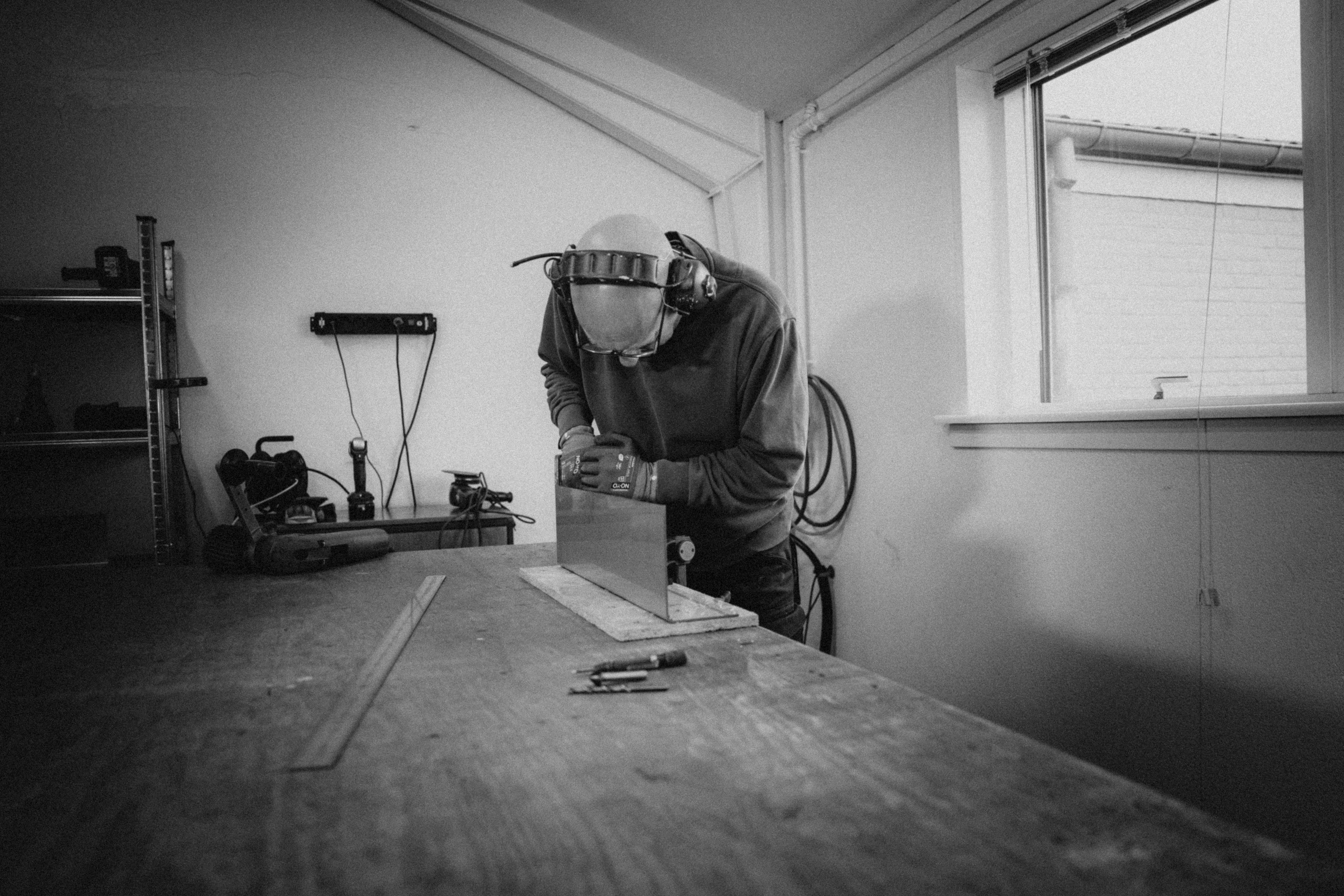
The image captures the actual pace of production at Acier Studio. The component on the bench is held low for ergonomic control; heat is introduced gradually so the panel stays flat without oil‑canning. Corners are mitred rather than butted for a continuous line, which reduces local stress and helps the grain run cleanly around edges after finishing. Power tools are within reach, but the sequence is hand‑led so each step—tack, weld, cool, dress, check—is deliberate.
Product insight: Copenhagen coffee table
The Copenhagen coffee table reflects the Danish habit of making the join a design element rather than something to hide. Its frame is TIG‑welded, then dressed until the weld transitions are visually quiet and the brush lines register from plane to plane. The top panel is stiffened to stay planar; surfaces are finished in a satin brush that resists fingerprints better than mirror and reads softly in natural light. Underside glides protect floors and allow micro‑levelling on older timber boards. The overall effect is minimal, but the construction logic is exacting: tight mitres, controlled heat input, and grain continuity are what keep the table reading crisp after years of use. See the piece here.
Maintenance that preserves the passive layer
Stainless steel is forgiving if the passive film is respected. Daily care can be simple: wipe with a damp microfibre cloth, then dry to avoid water marks. For fingerprints, use a small amount of isopropyl alcohol on a soft cloth, or a pH‑neutral stainless cleaner appropriate for brushed finishes. Always wipe in the grain direction on No.4 or hairline surfaces. Avoid bleach, chlorine sprays, and hydrochloric or muriatic cleaners; chlorides attack the passive layer and invite pitting over time. Do not use steel wool, which embeds carbon steel and later rusts.
For periodic refresh on brushed surfaces, a fine nonwoven pad can realign the grain; work lightly and uniformly. If tea‑staining or minor surface rust appears, a citric‑acid passivation gel can remove contamination and re‑enrich the chromium oxide film; rinse thoroughly and dry. In coastal interiors, more frequent rinsing and drying will keep deposits from building. Correct care is straightforward, but it is also decisive for longevity.
The Danish small‑batch system as long‑term value
Small runs in Denmark function as a quality system. Local sourcing and fabrication mean alloy choice, welding parameters, and finishing are set by the same team, then verified at the bench. This short loop is the practical reason the surface you receive stays stable; the workshop can slow down for delicate joints, reject heat‑tinted sections, and re‑passivate before assembly. The approach has roots in the Danish metal furniture tradition where material honesty and precision are foregrounded, and it suits stainless steel particularly well.
Acier Studio documents its approach to material grades, grain selection, and finishing sequences in its workshop notes; see the overview here. These decisions carry through to serviceability. Repairs and refinishing are feasible because welds are accessible and finishes are reproducible. Over time, that consistency compounds value. Surfaces remain coherent with the architecture; structural integrity does not drift; pieces can be maintained rather than replaced. In a living environment, this is what durable design looks like: fewer compromises at the weld and the finish, more years of calm, functional use.

