

Brass Shelf Brackets: Function, Dimensions, and Golden Details
Brass brackets do two things at once: they bear the weight of your shelf, and they add a warm, precise line to the wall. Therefore, every choice begins with function. A visible bracket must have an arm and height that match the shelf's depth and load; for most domestic scenarios, this means a bracket arm of 180–280 mm for shelves 200–300 mm deep. As a rule of thumb, the bracket arm should cover at least 70 percent of the shelf's depth. The mounting holes should be located within a vertical field of 80–120 mm to distribute forces evenly in the wall.
Load capacity depends on wall type, screw dimension, and the distance between brackets. Two brackets in solid masonry with 5–6 mm screws can often handle 20–40 kg per shelf, provided a solid shelf of 20–30 mm. In plasterboard walls, you must secure them into studs or use cavity anchors according to the manufacturer's instructions; here, the safe load decreases significantly. The distance between brackets is typically 50–60 cm for compact wooden shelves and 40 cm for thin veneer shelves. Longer shelves require a third bracket to prevent sagging.
Visible brass fittings are best read when the shelf has a calm profile. This allows the material to stand out as a "jewel" in the room. Design editors point out that warm metals play beautifully against medium-dark wood types like walnut and oiled oak, or against matte, light walls; here, the golden hue functions as a rhythmic repetition rather than an effect. Architectural Digest refers to warm metals as a jewelry detail that should be repeated in a few places for visual balance.
Materials and Corrosion Understanding: Brass, Stainless Steel, and Golden Finishes
“Brass” can mean several paths to a golden expression:
- Solid brass; warm tone, can patinate, and requires maintenance.
- Stainless steel with golden PVD or chemical coloring; more color-stable, harder surface.
- Brass plating on steel; requires proper pre-treatment for adhesion.
If you combine brass fittings with stainless steel shelves or screws, it's relevant to consider galvanic compatibility. Fastenal describes that different metals in humid environments can accelerate corrosion in the least noble partner; small nylon or fiber insulators between metals, as well as correctly chosen stainless steel quality, limit the risk. In dry, indoor environments, this is rarely a problem when fittings and screws are properly surface-treated.
Stainless steel protects itself with a thin, self-repairing layer of chromium oxide. As Outokumpu describes, steel quality and surface finish affect resistance to staining and pitting; 304/304L is standard indoors, while 316/316L is recommended in coastal or humid rooms. A smoother finish, e.g., brushed or polished, improves atmospheric resistance. This is important if your golden fittings are PVD on stainless steel; the base material and processing determine how stable the color is over time.
For a more technical look, golden fittings can play against cool materials. A thin steel shelf with a tight profile allows the fitting to stand out as an accent next to the cool precision of the steel; see, for example, our simple profile in the Bergen series: https://acier.dk/products/staalhylde-bergen
Mounting and Spacing — A Practical Guide
Secure mounting begins with the wall. Brick and concrete provide robust anchor points. In plastered walls, you need to go past the plaster layer into the mass. In plasterboard, it's crucial to find studs. Always use washers that protect the finish if the fitting is lacquered or PVD-treated.
- Choose 5–6 mm screws for brick/concrete with appropriate rawlplugs, 4.5–5 mm wood screws for studs; length should be at least 50 mm in load-bearing material
- Maintain 50–60 cm between brackets for solid wood shelves, 40 cm for veneered; add a middle bracket for shelf lengths over 120 cm
- Pre-drill in wooden shelves with 1 mm smaller than the screw core; avoid splitting veneer
- Use a spirit level and mark holes with the bracket as a template; tighten evenly to avoid twisting the bracket
- Isolate dissimilar metals in the kitchen and bathroom with thin nylon washers between screw head and fitting
- Test-load the shelf gradually; listen for creaking and retighten after 24–48 hours
Maintenance in Practice
Solid brass develops a natural patina. If you desire a consistent golden tone, you can protect the surface with microwax and wipe it with a microfiber cloth. Avoid ammonia-based polishes, which can attack the alloy. Lacquered brass is washed with mild soap and water; avoid abrasive sponges that dull the lacquer.
Golden PVD layers on stainless steel are hard but not indestructible. Clean with lukewarm water, pH-neutral soap, and a soft cloth. No chlorine-based agents, no steel wool. In coastal environments or bathrooms, we recommend that the base itself be 316/316L; as described by Outokumpu, this provides an increased margin against corrosion in high humidity. If you have mixed metals, inspect annually for initial discoloration at contact points. Dismount and clean washers and screws as needed; replace worn washers before the finish is damaged.
Product Insight: Lund Wall-Mounted Bedside Table in Stainless Steel
Lund demonstrates how precise metal processing looks light on the wall, even when the fastening is visible. The shape is folded in a clean cut with tight radii, so surfaces meet sharply and bear weight without visible reinforcement. The brushed steel surface catches light uniformly; two visible mounting screws are rationally placed and honestly reflect the function.
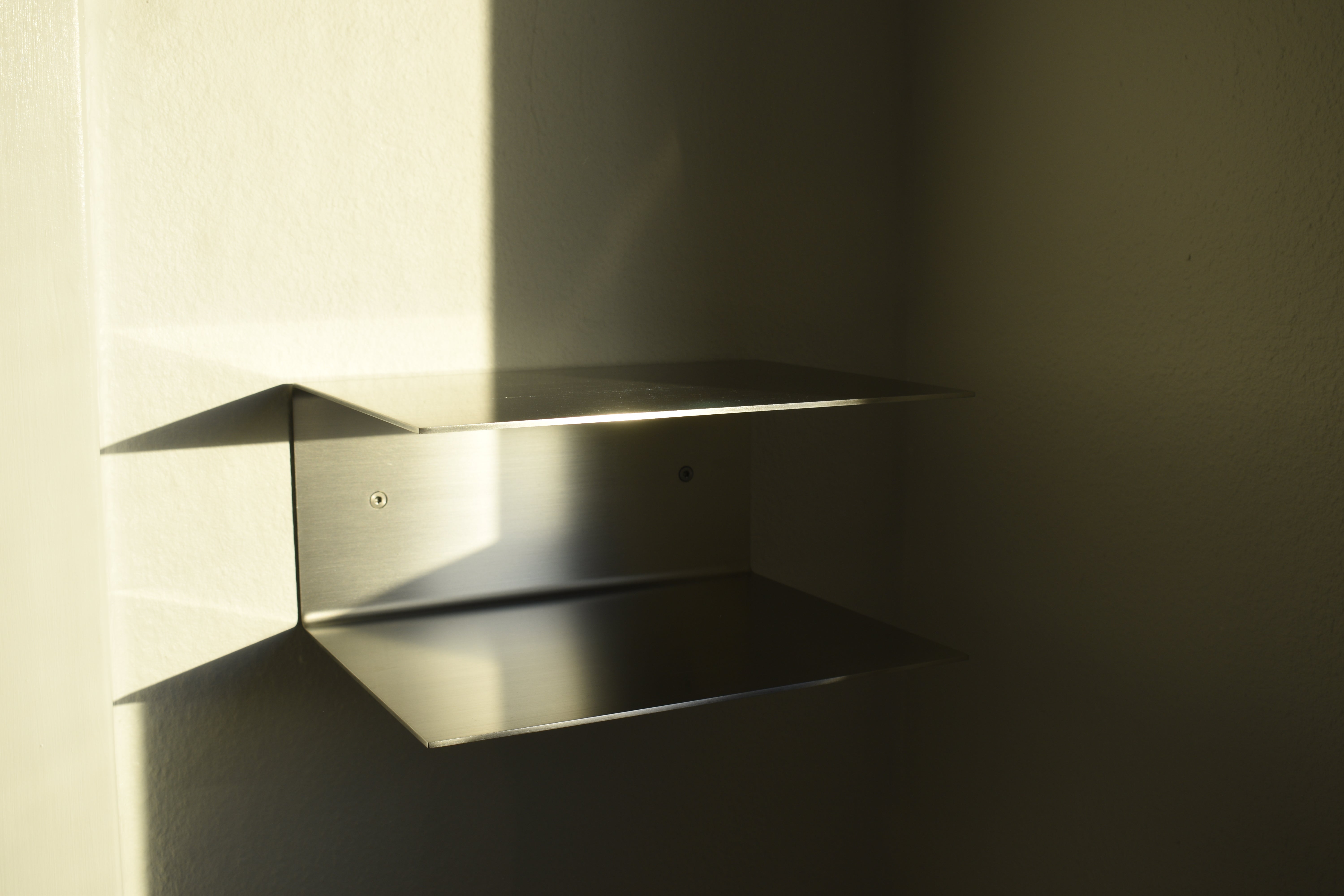
The image is unstyled, which emphasizes geometry, tolerances, and the interplay between wall and furniture. This reading is useful when dimensioning visible shelf brackets: let the detail be precise, sober, and consciously placed. Our practice in Aarhus is based on hand-processing, tight tolerances, and documented surfaces; this matches the Danish design tradition, which Danish Design Council describes with a focus on simplicity, function, and craftsmanship. With local craftsmanship, thicknesses, radii, and fittings can be adapted, whereas mass production must choose standard.
The perspective in interior design is the same as in construction: when the support is resolved beautifully and honestly, the visible detail becomes a calm part of the wall.
In conclusion, brass brackets are about more than color. Choose the right geometry, a well-supported material strategy, and honest mounting. Stainless steel with the correct finish provides long-term stability; brass adds warmth that can live and patinate. With components that can be retightened, finishes that can be maintained, and craftsmanship that can be repaired, you get a solution with low life cycle costs and high design integrity over time. In rooms with humidity or near the coast, 316-based solutions provide an extra safety zone, while dry rooms are well-suited for 304. A good bracket is not a one-time solution; it is a calm, enduring part of the wall.

