

Shampoo shelf that lasts: why solid stainless steel wins in the bathroom
A shelf in the shower area must withstand constant moisture, soap residue, cleaning agents, and temperature changes. Most solutions fail because the material is the weak link. A shampoo shelf made of solid stainless steel, chosen in the correct alloy and with the right surface finish, solves precisely the mechanisms that cause plastic and chrome-plated steel to give up.
Why plastic and chrome-plated shelves fail
In wet rooms, material physics, not accessories, determines longevity.
- Plastic does not rust, but it is not inactive: its surface attracts dust and soap residue, which create nutrients for biofilm; in warm, humid bathrooms, this can turn into visible mold on the plastic itself. At the same time, plastic ages hydrolytically and from UV light, making it brittle, discolored, and harder to clean over time.
- Chrome-plated shelves are a layer-by-layer coating, typically copper, nickel, and finally a thin layer of chrome. The coating is porous; microscopic holes and edges allow water and chemicals to penetrate. The result is patchy corrosion beneath the coating, blistering, and eventually flaking. Once the chrome is breached, corrosion accelerates in humid, chloride-rich environments like shower stalls.
The contrast to a shelf made of solid, uncoated stainless steel is clear: there is no coating to penetrate, no polymer to age, and no layers to delaminate.
Stainless steel in wet rooms: passive film, alloy, and finish
Stainless steel forms a self-repairing, chromium-rich oxide film on its surface. This passive layer provides broad corrosion resistance; if disturbed, it rebuilds in contact with oxygen. According to the British Stainless Steel Association, the film provides strong resistance to general corrosion in moist environments, while critical failures in chlorides are pitting and crevice corrosion, which are handled with the correct alloy and surface treatment (see British Stainless Steel Association).
This has three practical consequences for a shampoo shelf:
- The alloy should be chosen for the environment. 316 steel with molybdenum is more resistant to chlorides than 304; close coastal proximity or hard, chloride-rich water calls for 316.
- The surface must be even and dense. A fine, brushed or satin finish reduces micro-scratches where dirt and chlorides can accumulate; polished and properly passivated welds minimize crevices where water can stand.
- The construction should avoid unnecessary joints. Fewer screws and joints reduce the risk of crevice corrosion around washers and fittings.
The sum is a shelf that does not "rust under the coating," because there is no coating at all; instead, one works with a homogeneous alloy where protection is integrated into the material.
Danish manufacturing, fewer weaknesses
In Aarhus, Acier Studio works with small series in solid stainless steel. This allows for details that make a difference in wet rooms: precise TIG welding, post-processing that aligns the grain direction in grinding, and tight tolerances that minimize crevices. Joints are ground and passivated so the surface is continuous; sharp edges are rounded just enough to facilitate cleaning, but without breaking the simple geometry.
This approach contrasts with mass-produced, stamped and coated components. When everything is one material, repair is also simple: a scratch can be carefully ground and passivated locally, without destroying a coating. It is the same functional discipline that characterizes Danish modernism, translated into a wet room environment where durability is an aesthetic concern.
Skagen in use
Skagen is Acier Studio's wall-mounted steel shelf, designed for both kitchen and bathroom. In the kitchen, it appears as a calm, flat surface in brushed steel that accommodates and organizes daily use without dominating. It works just as well in a shower niche, where shampoo and soap stand stably and can dry unhindered on a non-porous surface that dries quickly.
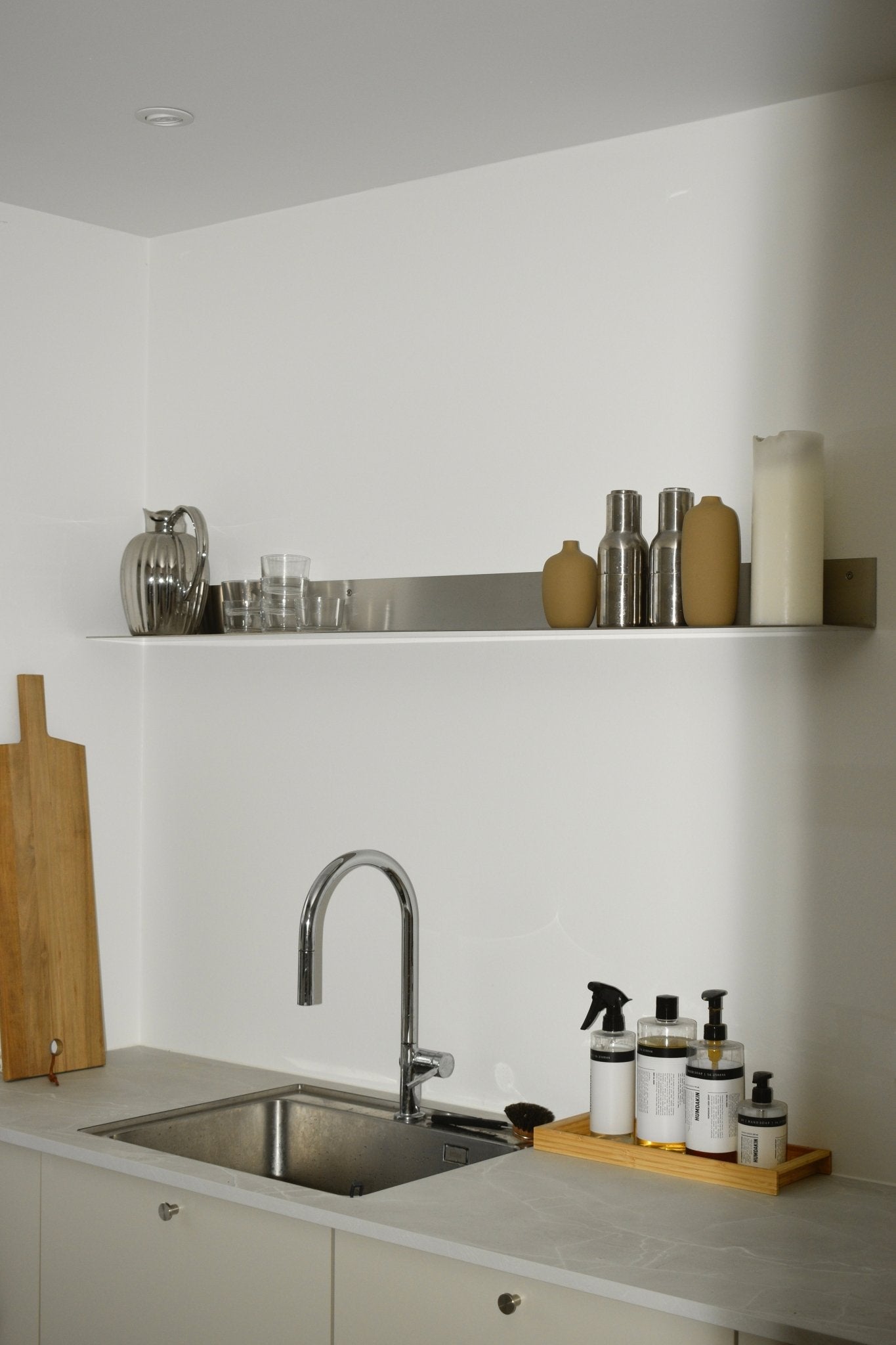
In the picture, Skagen is mounted on a white wall above a kitchen sink with a chrome faucet below. The shelf holds steel and ceramic objects side by side: a steel pitcher, drinking glasses, oil and vinegar bottles, ochre vases, and a large pillar candle; a wooden cutting board leans against the wall. The brushed surface reads neutrally, binds steel elements together, and plays cleanly with wood and ceramics. In a bathroom, the same finish provides a subdued expression that harmonizes with matte tiles, honed stone, and warm wood details. For coastal bathrooms, the 316 version is recommended, and always welded, ground joints for lasting peace of mind.
See the product here: Skagen steel shelf
Maintenance, step-by-step and honest
Stainless steel requires less maintenance than coated materials, but it is not maintenance-free.
- Clean weekly with lukewarm water and pH-neutral soap. Rinse, and wipe dry with a soft microfiber cloth to remove water film.
- Avoid chlorine-containing cleaning agents, hydrochloric acid- or bleach-based products, and steel wool. They can promote pitting or leave foreign iron that discolors.
- Remove limescale with a mild vinegar solution, rinse thoroughly, and wipe dry. On satin surfaces, a fine non-abrasive scouring pad can be used along the grain.
- If you see "teastaining" or brown shadows, it is often due to settled iron from the surroundings. Use a citric acid-based stainless steel cleaner, rinse, dry, and allow the surface to re-passivate in air. Deep scratches can be carefully spot-sanded and then cleaned and passivated.
- In coastal homes: choose 316 steel, and increase the frequency of rinsing and wiping so that salts do not accumulate in crevices.
A practical detail in daily use is to keep the shelf's contact surfaces free of soap deposits; they bind moisture and chlorides. An even, dense grind and welded joints make this easier, as there are fewer places for water to stand.
In conclusion, a shampoo shelf made of solid, correctly processed stainless steel is an investment in everyday peace of mind. The material carries its own protection, can be serviced without losing its finish, and patinas slowly through use rather than flaking off. Over time, it is the difference between replacing a coating and living with a piece of functional furniture that remains in the room because it was done right from the start.

