

Steel coffee table: function, material, and purposeful serenity in the living room
A steel coffee table solves three tasks at once: it bears weight without yielding, it withstands daily use, and it receives light in a controlled manner. In stainless steel, this robustness comes from a passive chromium oxide film on the surface; the film forms spontaneously when the alloy contains sufficient chromium, and it regenerates with minor scratches. As described by Outokumpu – on corrosion resistance, this mechanism provides the characteristic resistance to stains and corrosion that makes the material suitable for a coffee table in a living space. A brushed, directional finish reduces glare and makes minor signs of use read as a unified, serene patina over time, rather than as individual scratches.
The material that works with light: 304 and 316 in a brushed finish
For interiors, austenitic grades such as 304/304L and 316/316L are the most commonly used; 316 has higher resistance to chlorides and pitting corrosion and is relevant if the table is placed close to coastal environments, in kitchens, or in conditions with frequent contact with salts. The surface matters as much as the alloy. A directional No.4 brushing leaves an even satin track, which:
- dampens reflections so the table doesn't dominate,
- hides fine, longitudinal micro-scratches,
- controls how the patina distributes when cleaning along the grain.
The finish requires proper maintenance. Mild, pH-neutral detergent and wiping in the direction of the brush grain limit transverse swirls. Occasionally, a light passivation (often citric acid-based) can renew the protective film and remove incipient tea-staining; Outokumpu describes this relationship between passive film and corrosion behavior in detail on their page about corrosion resistance.
Aarhus-manufactured craftsmanship: why Danish processing is visible over the years
In a small Danish workshop, quality is assembled before it is seen: material selection without contamination, precise component measurement, TIG welding with controlled heat input, and subsequent grinding where weld seams are planed and the brushing is blended so that the grain runs uninterrupted across surfaces and edges. When production is close to the design studio in Aarhus, quality control follows all the way; tolerances can be adjusted, and repair is realistic if something happens during transport or use.
This approach is not new in Denmark. Institutional networks and museums document the tradition of metal craftsmanship and design as part of Danish workshop culture; Dansk Kunsthåndværk & Design (DKoD) has for years described these professional environments and their importance for durability and repairability in everyday objects (see dkod.dk for background). This is the difference between a weld seam that is merely covered by a coating, and a seam that is metallurgically clean, flat, and integrated into the whole; the former ages unevenly, the latter becomes part of the overall patina.
Copenhagen coffee table with Oslo pedestal: an interplay in muted steel
Acier Studio's Copenhagen coffee table works on a low scale, so the living area remains open, while the table surface clearly gathers the room's activity. In the matte, light steel tone, the surface reads as calm and tactile rather than reflective; the directional strokes cause light to glide across the table without harsh flashes. Styling in a neutral living room with a linen sofa and dark ceramic objects on the tabletop shows how the material can stand as a calm contrast to soft textiles. To the left, the Oslo pedestal emphasizes the pair's composition; it holds a wooden object and creates a vertical rhythm that supports the table's horizontal center of gravity. Together, the two pieces of furniture read as a measured, architectural gesture that can easily be expanded with books, trays, or bowls without breaking the whole.
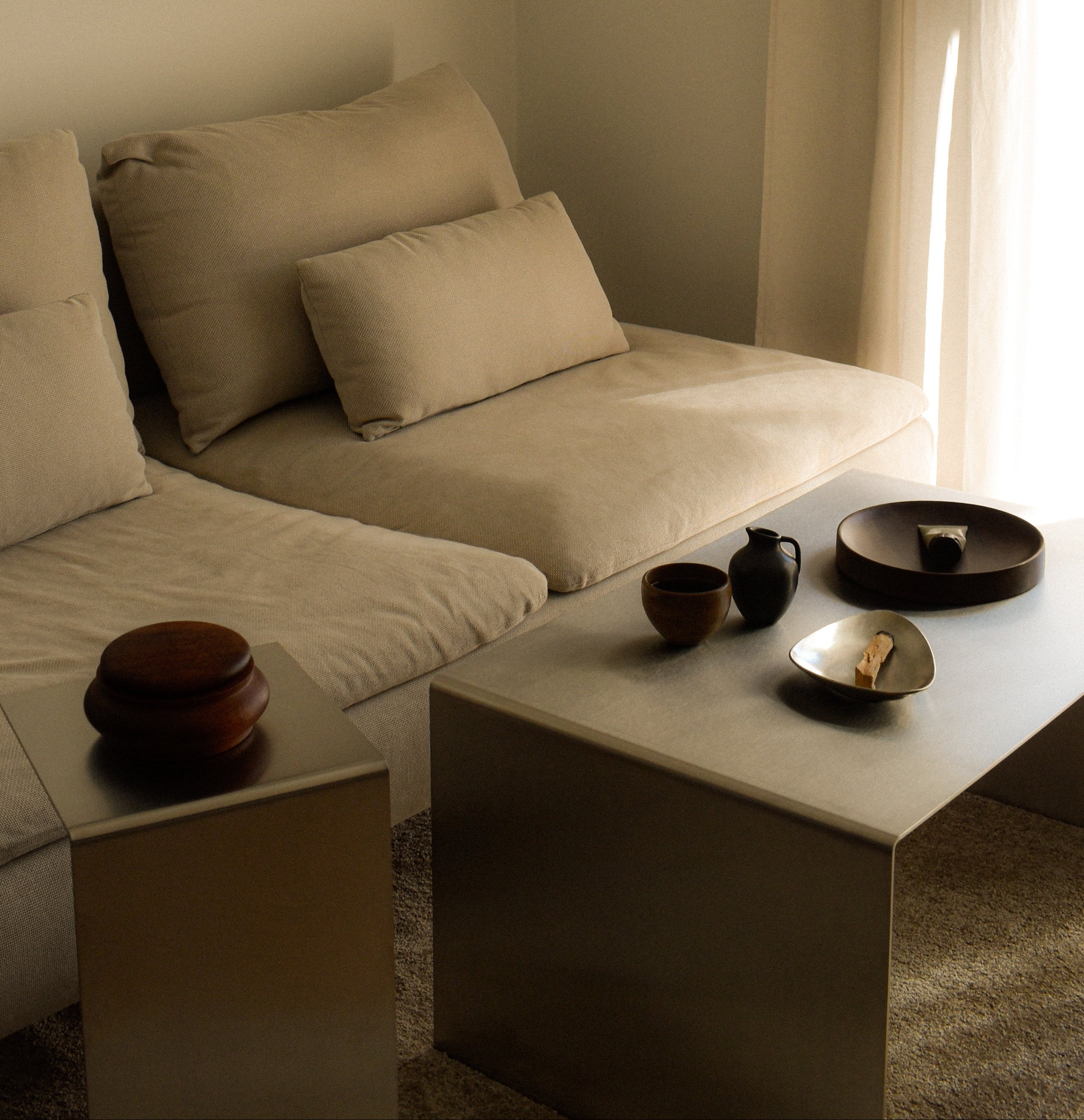
If the proportions appeal, you can see more pictures and dimensions under Copenhagen coffee table at acier.dk.
The direction of the brushing can advantageously be oriented parallel to the room's primary view or window light. This provides a more uniform reflection and a patina that develops logically with use, because each wipe follows the same grain direction.
Placement and material encounters in the living room
A steel coffee table reads modern and neutral, but never becomes cold when it matches warm materials. In practice, light oak or walnut, natural leather, and coarse wool textiles provide a calm counterpoint. A stone or terrazzo tray on the table adds minerality and collects small items. Keep the overall height low and allow space around the table; place it centrally between seating areas with clear passage, so the surface is easy to reach from all sides. Editors at Wallpaper have repeatedly pointed out during 3 Days of Design how metal surfaces in muted interiors become more tactile when contrasted with fabric and wood textures; this is especially true for brushed steel, which rewards touch rather than mirroring its surroundings (see wallpaper.com for case studies).
Maintenance and specifications that make the difference
Daily care is simple but must be consistent. Use lukewarm water and a mild, pH-neutral dish soap with a soft microfiber cloth; wipe in the direction of the brush grain, rinse off any soap residue, and dry afterwards to prevent limescale marks. Fingerprints are effectively removed with isopropyl alcohol on a clean cloth, after which you wash lightly and dry again. Avoid chlorine-containing agents, bleaches, scouring cream, or coarse sponges; they can cause pitting corrosion or transverse scratches that are harder to blend into the grain. In homes near the coast or a swimming pool, light tea-staining may occur; here, periodic, supplier-recommended passivation (often a citric acid gel) and a consistent wiping routine help. Adhesive residues from tape are best removed with a citrus- or alcohol-based solvent, wiped off, and the surface then washed as normal.
When specifying or ordering a steel coffee table, the following are worth getting in writing:
- Alloy: 304/304L for general living spaces, 316/316L in the presence of chlorides or outdoor proximity.
- Sheet material and finish: e.g., 2B as base, followed by No.4 directional brushing.
- Documentation: material certificate (mill test), possibly a passivation certificate for welded items, and a maintenance guide describing grain direction and suitable cleaning agents.
This kind of precision in specification and maintenance not only extends the lifespan; it also ensures that the patina develops evenly and can be renewed with careful re-grinding if an accident occurs.
Long-term value
A stainless steel coffee table from a Danish, workshop-based production combines a material with inherent resilience and a finish that makes the surface easy to live with. When welding, grinding, and brushing are conceived as one system, the table ages gracefully, and small signs of use are integrated into the overall impression. At the same time, the construction is repairable, and spare parts or re-grinding can be done locally. Over the years, this means lower overall resource consumption and a piece of furniture that continues to occupy a central place in the room without demanding attention; this is precisely the kind of long-term value that makes sense in a Danish living room.

