

Stainless steel coffee table durability
Stainless steel holds its geometry under daily use, resists corrosion in ordinary indoor environments, and can be refinished when marked. It is not scratch‑proof, but it tolerates abrasion far better than marble and it does not depend on vulnerable coatings like lacquer. For coffee tables that must live with cups, books, ceramics, and constant cleaning, this combination of dimensional stability and recoverable surface makes stainless steel the most durable choice.
The material basis of durability: passive film and dimensional stability
Stainless steel protects itself chemically. Once chromium content is approximately 10.5% or higher, the alloy forms a thin, chromium‑rich oxide that continuously re‑establishes in air and moisture. This passive film keeps the underlying metal stable and limits staining, unlike ordinary carbon steel. The British Stainless Steel Association explains this self‑healing behavior in detail, and why it endures in normal indoor atmospheres where chlorides are minimal (British Stainless Steel Association).
Equally important is mechanical stability. Austenitic stainless steels, such as 304 or 316, have high toughness and do not chip like stone. They do not swell, warp, or crack with humidity; there is no fibre direction or veneer glue line to fail. A stainless tabletop retains flatness through seasonal change, which keeps joints true and edges crisp over time.
Abrasion, scratch visibility, and finish choice
Scratch resistance is a function of hardness, contact pressure, and the presence of hard grit. Fine quartz particles under a mug can score any material, including stainless. The key is how visible wear becomes and how easily it can be corrected. Finish selection matters:
- Brushed/satin: Linear grain diffuses light and disguises fine abrasion. Minor scuffs can be blended along the grain with a non‑woven finishing pad and light oil.
- Bead‑blasted: Even matte, very low glare. Hides fingerprints and general wear, but spot repairs must be feathered carefully to avoid gloss variations.
- Mirror‑polished: Highest reflectivity, visually crisp edges. Shows hairline scratches readily and requires specialist polishing to restore a flawless surface.
Proper passivation after fabrication and clean handling during finishing reduce contaminants that could interfere with the passive layer and keep the appearance consistent across planes.
Copenhagen coffee table: precision at the corner
Acier Studio’s Copenhagen coffee table demonstrates how form contributes to longevity. At the corner, the tabletop is brought down into a precise fold that meets the side panel with a tight radius and a clean, aligned seam. The brushed grain runs straight and uninterrupted, which indicates controlled bending and hand finishing rather than mass-stamped panels. This geometry stiffens the top edge without adding parts and gives a robust tactile line that stands up to contact.
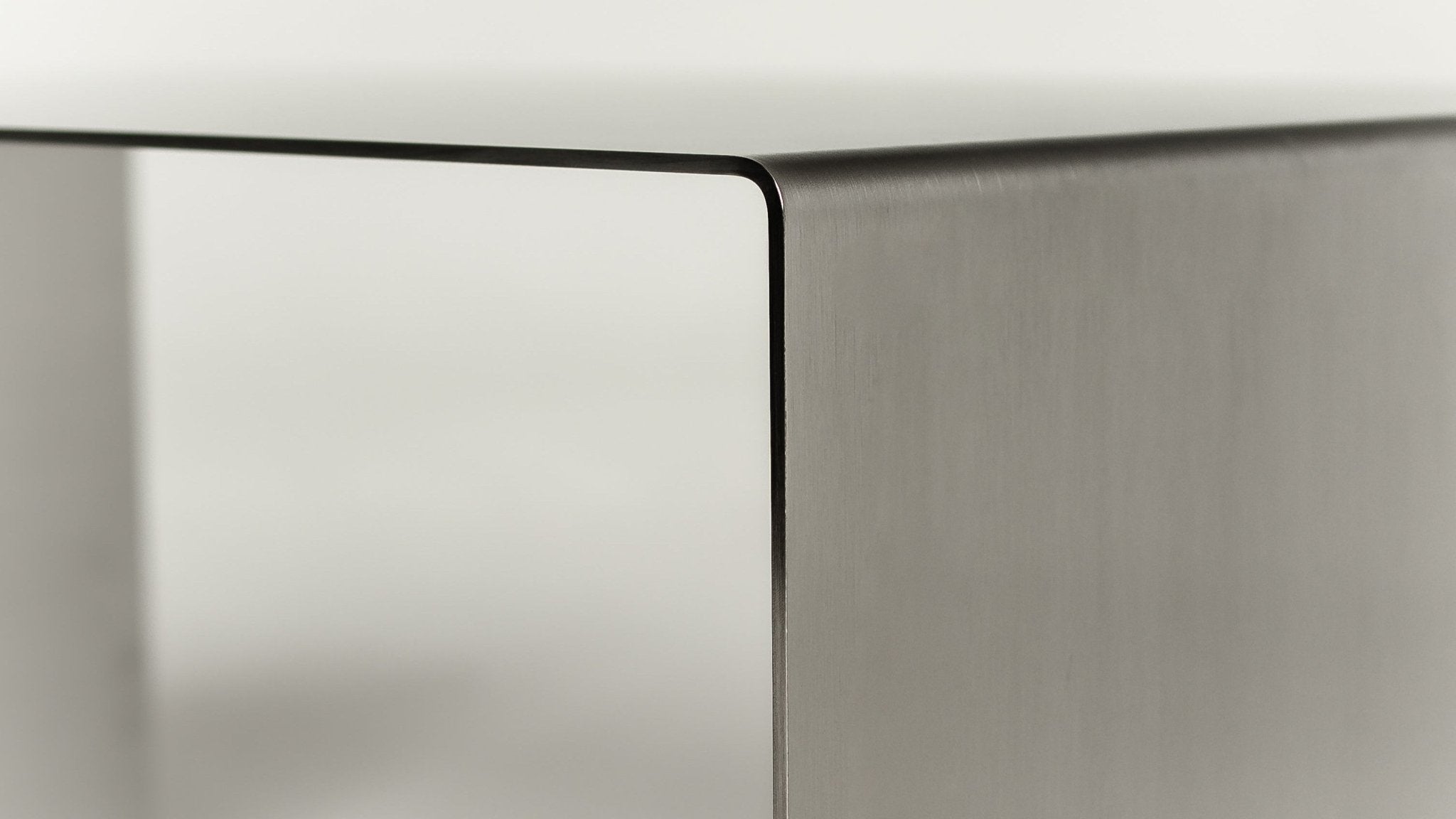
The close radius also reveals material quality; consistent grain density and a burr‑free edge show that the stainless has been cut cleanly, then formed on accurate tooling before the final brush is drawn. For specifications and finish options, see the Copenhagen coffee table.
Danish craft in Aarhus and why it matters
Durability emerges in the workshop long before a table meets a living room. Small‑batch production in Aarhus allows controlled TIG welding where it is structurally necessary, careful deburring and edge dressing, and grain‑true brushing across assembled planes. Each of these steps reduces stress risers, prevents crevice traps, and ensures the passive layer forms evenly after cleaning and passivation. This is the practical side of Danish craft values: material honesty, precise joinery in metal, and an insistence on finish continuity that holds up under touch and light. Read more about these processes in Production and materials.
Marble and lacquered wood: meaningful differences in real use
Marble is relatively soft for a stone; it is a calcite rock and can scratch or bruise under point loads. Everyday acids like citrus can etch polished marble, leaving matte rings that require resurfacing. Edges chip with impact because the material is brittle.
Lacquered wood depends on a film. High‑quality catalysed lacquers increase surface hardness, but the coating still sits above a hygroscopic substrate. Seasonal movement can stress mitres and seams, and repeated abrasion eventually dulls or breaks the film. When damage occurs, spot repair often reveals a witness line or gloss mismatch, and full refinishing is invasive.
Stainless steel avoids these mechanisms. It does not etch with drinks, it will not swell at joints, and its surface can be re‑brushed or re‑polished in place when marked.
Maintenance that preserves the finish
- Wipe routinely with a soft microfibre cloth and warm water. For fingerprints, use a drop of pH‑neutral dish soap, then rinse and dry along the grain.
- Avoid bleach, chlorine‑based bathroom sprays, and acidic descalers that can interrupt the passive film. If contact occurs, rinse thoroughly and dry.
- Place felt or cork under ceramic or stone objects to isolate hard grit. Coasters are useful primarily as grit barriers rather than for moisture protection.
- For brushed/satin tops, blend light scuffs with a fine non‑woven finishing pad and a small amount of mineral oil, always moving with the grain and testing in an inconspicuous area first. Do not attempt this on mirror finishes; consult a professional polisher instead.
- If a table has seen aggressive cleaning or building dust, a professional re‑finish can restore uniform grain and repassivate the surface during the final clean.
Over a long horizon, stainless steel’s value is cumulative. The alloy maintains its shape, resists indoor corrosion through a self‑healing film, accepts repair without thinning to a veneer, and ages with a quiet, even sheen. In a Danish interior where materials are expected to last and to be maintained rather than replaced, a well‑made stainless coffee table offers stable geometry and serviceable surfaces that hold their standard year after year.

