

Stainless steel shelf hygiene: why passive, non‑porous surfaces keep kitchens cleaner
Stainless steel is the most hygienic shelf material because its surface is chemically passive, non‑porous and—when correctly finished—smooth enough to resist bacterial and mould colonisation. Food‑contact regulations summarise the requirement clearly: surfaces must be smooth, non‑absorbent and easily cleanable. Shelves above sinks, cooktops and in wet rooms meet that standard most reliably in stainless, provided the alloy and finish are specified with hygiene in mind.
The passive oxide film and why alloy choice matters
At the core of stainless steel’s hygienic behaviour is a chromium‑rich oxide film that forms spontaneously when the alloy contains at least about 10.5% chromium. This nanometre‑thin layer is self‑healing in the presence of oxygen; if it is scratched during use, it reforms, maintaining corrosion resistance and preventing the pitting that traps microbes. The effect is well documented by Outokumpu, whose overview of corrosion resistance explains how alloying and passivity work together to protect the surface (see Outokumpu: https://www.outokumpu.com/en/expertise/2020/the-power-of-corrosion-resistance).
Because the oxide is continuous and adherent, the substrate remains non‑porous under normal kitchen exposure. That limits moisture ingress and undermines the micro‑habitats where biofilms develop. In practice, this means fewer crevices for residues, faster drying after cleaning and stable performance across daily temperature and humidity swings.
Finish and roughness: controlling adhesion and biofilm formation
Material is only half of the hygiene story. Surface finish and roughness (Ra) govern how readily bacteria can attach, spread and be removed. Smoother, more uniform topographies present less mechanical anchoring and clean more predictably.
- Mirror polish (low Ra): maximises smoothness and reduces attachment; used where visual reflectivity is acceptable
- #4 brushed (typical kitchen grain): balances low Ra with glare control; hygienic when the grain is even and the finish is closed
- Electropolished: micro‑level levelling that reduces Ra further and removes embedded contamination from fabrication
Across food and medical equipment, Ra targets typically sit in the sub‑micrometre range; the principle for shelving is similar. Even a practical #4 brushed shelf will perform well if the grain is consistent, welds are dressed flush and no pits or tooling marks remain. Electropolishing further decreases bacterial adhesion and eases cleaning in demanding environments.
Danish small‑batch craft as a hygiene detail, not decoration
Hygiene depends on geometry as much as chemistry. In Aarhus, Acier Studio fabricates in small batches with welded and ground joints, tight tolerances and repeated hand‑finishing. Fully dressed seams remove capillary gaps where moisture lingers. After fabrication, in‑house passivation restores and strengthens the chromium oxide layer affected by heat from welding and grinding. This is a crucial but often skipped step in mass production; stamped parts, powder coatings and unfinished welds may mask roughness or trap contaminants that later compromise cleanability.
Consistent brushing establishes a uniform grain that cleans in a single direction; internal corners are eased just enough for access without losing architectural clarity. Quality control remains on site, so grain, flatness and edge radii are checked together. For a closer look at these methods and material choices, see Acier Studio’s Production and materials page: https://acier.dk/en-us/blogs/news/production-material
Skagen wall‑mounted shelf: hygienic detailing in use
Skagen is Acier Studio’s wall‑mounted stainless steel shelf, designed for kitchens and wet zones where wipe‑down speed and durability matter. Installed above a sink, it shows how a carefully executed #4 brushed grain reads calm yet remains practical; the linear texture guides cleaning and visually aligns with taps and appliances. The open underside and planar top mean there are no hidden lips to trap splashes from the basin below. Everyday objects—steel jug, glasses, oil and vinegar bottles, ceramic vases and even a candle—sit on a stable, non‑absorbent surface that tolerates spills and heat without swelling or staining.
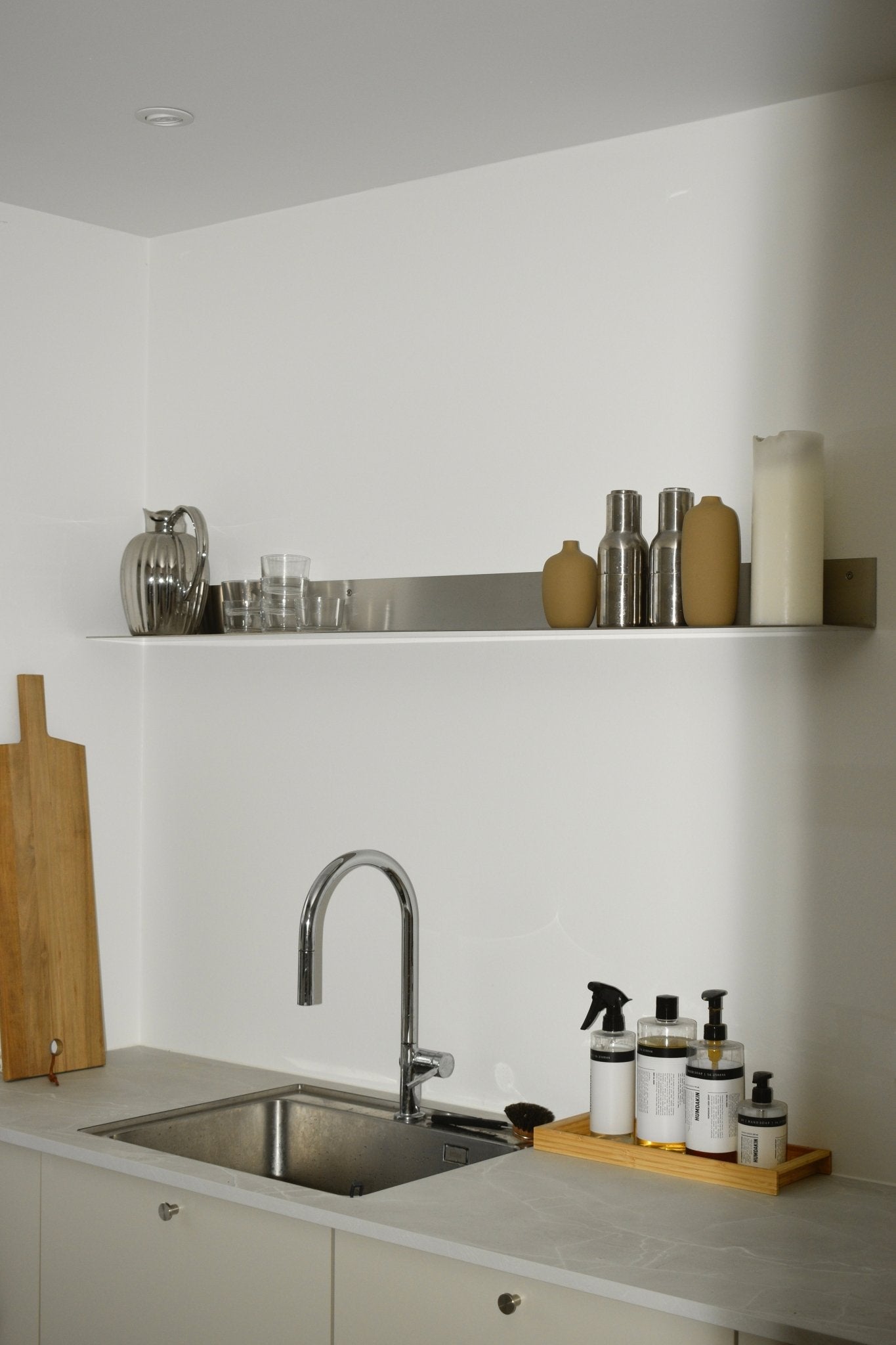
Mounting is discreet; the shelf reads as a floating plane and leaves space for light and air circulation, which speeds drying in a splash zone. In a Scandinavian interior, the cool hue pairs naturally with timber boards, pale stone and glass. See specifications and finishes here: https://acier.dk/products/staalhylde-skagen
Maintenance that preserves the passive film
Routine care is straightforward but benefits from precision.
Daily
- Wipe with warm water and a mild, neutral‑pH detergent; rinse and dry with a soft microfibre cloth along the grain to avoid streaking. Drying prevents mineral spotting and maintains the uniform appearance of the brush.
Weekly
- Remove limescale from hard water with a 1:3 solution of white vinegar to water or a citric‑based cleaner; apply briefly, rinse thoroughly and dry. Avoid prolonged contact with chlorides and never use bleach; chlorinated cleaners can undercut the passive layer over time.
As needed
- Address fingerprints with isopropyl alcohol, then rinse and dry. For tea‑staining near salt or coastal exposure, use a citric‑acid passivation gel following the manufacturer’s dwell‑time guidance, rinse, and dry; this helps recondition the oxide layer.
- Never use carbon‑steel wool or contaminated scouring pads; iron particles can embed and initiate rust staining. Choose non‑woven nylon pads rated for stainless and use lightly, with the grain, to avoid raising the Ra.
- If brackets or accessories are removable, take them off periodically to clean contact lines; reassemble dry to avoid trapped moisture.
With these practices, the passive film remains intact, the Ra stays within its intended range and the shelf continues to meet the “smooth, non‑absorbent, easily cleanable” benchmark expected of food‑contact surfaces.
Hygienic planning in Scandinavian interiors
Beyond the shelf itself, layout affects cleanliness. Keep shelves clear of tight corners and give at least a hand’s width above and below for access. Align grains horizontally for faster wipe‑downs, and position lighting to reveal, not conceal, residues; stainless reflects task lighting well, aiding inspection. Pairing steel with oiled oak, honed stone or clear glass balances temperature in the palette without compromising hygiene; all can be wiped to the same standard.
Long‑term value
A stainless steel shelf maintains its geometry and surface integrity over decades. The self‑healing passive layer resists corrosion, the non‑porous substrate avoids swelling or delamination, and professional refinishing is possible without replacing the piece. In practice, that means fewer chemical products, shorter cleaning cycles and a consistent appearance under real use. When fabrication quality is high and the finish is specified for hygiene, stainless becomes not only the cleanest option but also the most durable and predictable—qualities that underpin long service life in both domestic and professional settings.

